The most notable characteristic of bowerbirds is their extraordinarily complex courtship and mating behaviour, where males build a bower to attract mates. There are two main types of bowers. One clade of bowerbirds build so-called maypole bowers that are constructed by placing sticks around a sapling. The other major bower-building clade builds an avenue type bower made of two walls of vertically placed sticks. In and around the bower the male places a variety of brightly colored objects he has collected. These objects — usually different among each species — may include hundreds of shells, leaves, flowers, feathers, stones, berries, and even discarded plastic items, coins, nails, rifle shells, or pieces of glass. The males spend hours arranging this collection.


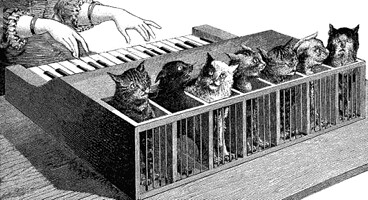 A Katzenklavier is a musical instrument with polyphonic aftertouch described by Athanasius Kircher. It consists of a line of cats fixed in place with their tails stretched out underneath a keyboard. Tails would be placed under the keys, causing the cats to cry out in pain when a key was pressed. The cats would be arranged according to the natural tone of their voices.


