Sort:  Alpha  Chrono  Rando

George Sitwell

George Sitwell was an unusual man. It’s tempting to dismiss the designer of a small pistol for shooting wasps as either a madman or a joker. The ever-serious Sir George was neither. He had a lot of time on his hands, that’s all. At a loss for something to do, Sir George began to compile a family history. When he wasn’t writing about his own family’s history, he was writing about the history of almost everything else, from Acorns As an Article of the Medieval Diet, The History of the Fork, and, The Errors of Modern Parents. He was careful, however, not to get too into writing, as he believed that novel writing had an ill effect on one’s health.

Neft Dashlari

In the 1950s, Soviet engineers built a massive city in the Caspian Sea off the coast of Azerbaijan. It was a network of oil platforms linked by hundreds of kilometers of roads and housing 5,000 workers, with a cinema, a park and apartment blocks. In Neft Dashlari's heyday, some 2,000 drilling platforms were spread in a 30-kilometer circle, joined by a network of bridge viaducts spanning 300 kilometers. Trucks thundered across the bridges and eight-story apartment blocks were built for the 5,000 workers who sometimes spent weeks on Neft Dashlari. The voyage back to the mainland could take anything between six and twelve hours, depending on the type of ship. The island had its own beverage factory, soccer pitch, library, bakery, laundry, 300-seat cinema, bathhouse, vegetable garden and even a tree-lined park for which the soil was brought from the mainland.

Bedaux Canadian subarctic expedition

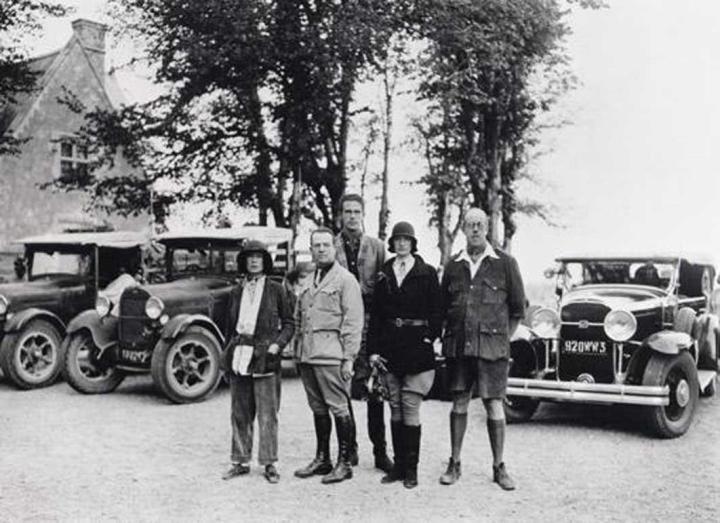
The Bedaux Canadian subarctic expedition has been described as one of the strangest journeys in the history of modern exploration. The brainchild of Charles Bedaux, a French-born naturalized American millionaire, it centred on an implausible scheme to drive five Citroen half-tracks and fifteen tonnes of supplies--including bottles of champagne and candied fruits--through the Rocky Mountains to the Pacific Ocean, following a trail that had not been attempted since Alexander Mackenzie in 1793. Bedaux was to be accompanied by an eclectic entourage that included: his wife, Fern; an Italian countess thought to be his mistress; an Academy-award winning Hollywood cameraman; a Swiss skiing instructor; a host of wranglers and cowboys; a dental student; an unemployed bush pilot; guides; geologists; and a British Columbia provincial surveyor.

Fragonard Museum

Founded in 1766, the Fragonard Museum is one of the oldest museums in France. Honoré Fragonard was one of the first medical masters of France, and his extensive collection contains rooms devoted to anatomy and teratology, articulated animal skeletons, and to disease and pathology. The highlight of this extraordinary museum is by far, however, the écorchés, or “flayed figures” of Honoré Fragonard. These écorchés were carefully dissected animals which were posed and mounted. While many of his contemporaries were creating artificial anatomy models from wax, ceramic and plaster, Fragonard spent years preparing hundreds of these écorchés through a very difficult and, to this day, secret process similar to that of plastination.

Hetty Green

Hetty Green nicknamed "The Witch of Wall Street", was an American businesswoman, remarkable for her frugality during the Gilded Age, as well as for being the first American woman to make a substantial impact on Wall Street. There are many tales about Hetty Green's stinginess. She never turned on the heat nor used hot water. She wore one old black dress and undergarments that she changed only after they had been worn out. She did not wash her hands and rode an old carriage. She ate mostly pies that cost fifteen cents. One tale claims that she spent half a night searching her carriage for a lost stamp worth two cents. Another asserts that she instructed her laundress to wash only the dirtiest parts of her dresses (the hems) to save money on soap.

Beauty Micrometer

The beauty micrometer was a device designed in the early 1930s to help in the identification of the areas of a person's face which need to have their appearance reduced or enhanced by make-up. The inventors include famed beautician Max Factor. Placed on and around the head and face, the beauty micrometer uses flexible metal strips which align with a person's facial features. The screws holding the strips in place allow for 325 adjustments, enabling the operator to make fine measurements with a precision of one-thousandth of an inch. The beauty micrometer was completed in 1932 and was primarily intended for use in the movie industry. The inventors also envisioned it being used in beauty shops. However, it did not become popular and did not gain widespread usage. Only one beauty micrometer is believed to exist. It is featured in a display at the Hollywood Entertainment Museum.